
Black-footed Ferret Cam


The Black-footed Ferret Cam has ended for the season! Thank you for supporting our ferret conservation program.
Peer into the den of one of North America’s rarest mammals.
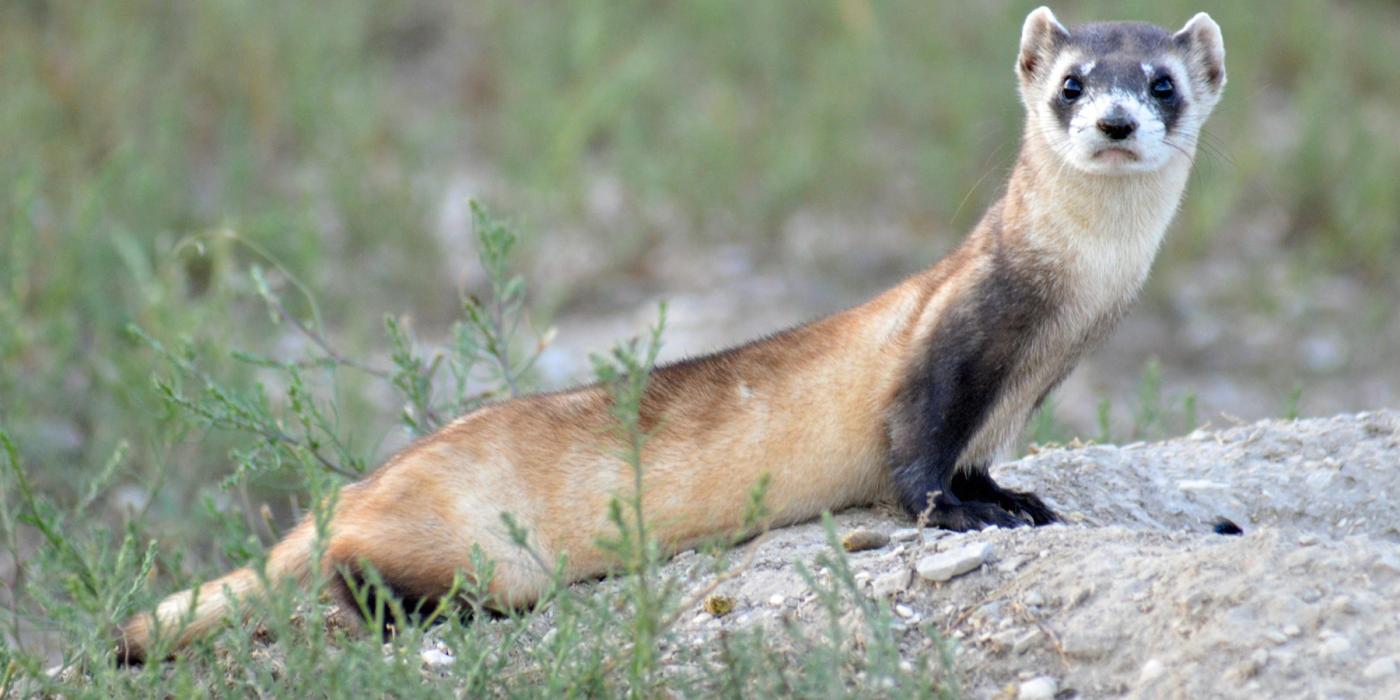
You’re looking at a family of black-footed ferrets, one of the most endangered animals in North America.
This family — 2-year-old mother Mizuno and her six kits — lives in a quiet indoor area at the Smithsonian Conservation Biology Institute in Front Royal, Virginia. They’re part of a conservation program that aims to help black-footed ferret populations recover in the western United States. Currently, 27 adult black-footed ferrets live at our facility as part of a managed breeding group.
Once thought to be extinct, a tiny population of 18 black-footed ferrets was discovered on a ranch in Wyoming in 1981. Thanks to cooperative breeding and release programs, the wild population has grown to approximately 300. All of the black-footed ferrets alive today — including the ones you’re looking at now — are descended from those 18.
Is That a Rat?
Yes! Our animal care team feeds the ferrets both frozen-thawed and live rats as part of their diet and to help mothers teach their kits crucial hunting skills for survival in the wild. Learn more in the Ferret Cam FAQ.
What You're Seeing Now
Meet Mizuno and her six kits, born on May 11, 2026, at our private research and conservation facility in Front Royal, Virginia. This temporary, black-and-white den cam offers an undisturbed look at the early life of a black-footed ferret, the only species of ferret native to the United States. The camera is intentionally soundless and low-light, allowing mother and kits to bond while animal keepers observe from a distance.
Growing Up, Fast
Life in the den moves quickly. In just a few months, Mizuno's six kits will transform from helpless newborns into skilled hunters:
- Birth – newborns are born blind, hairless, and entirely dependent on their mother
- Three weeks – eyes open, start to grow soft fur, and their signature mask-like face markings begin to form
- Four to five weeks – eating meat daily
- Six weeks– start venturing out of their den
- Seven weeks– first hunts of live prey to help build essential survival skills
- Three months – nearly full grown and ready to begin life on their own
Back From the Brink
Today, Smithsonian scientists are working on a series of projects to reverse the decline of this species.
Researchers at the Smithsonian's National Zoo and Conservation Biology Institute collaborate with the U.S. Fish and Wildlife Service to prepare human-raised black-footed ferrets for release into the wild. Some of the kits raised at SCBI enter a ferret preconditioning facility, where they learn how to hunt, burrow, and survive before setting out on their own.
Smithsonian scientists are also advancing new tools to strengthen the species’ genetic diversity. Assisted reproduction technologies, including artificial insemination, help improve gene flow and breeding success for the species. In 2024, a cloned ferret at SCBI birthed healthy offspring in 2024, reintroducing a genetic line once thought lost.
Beyond breeding efforts, researchers with the Smithsonian's Great Plains Science Program track reintroduced ferrets underground, fitting the animals with tiny collars to study how they navigate inside prairie dog burrows. Data from their studies aim to provide useful insights into the species’ path to recovery.
Explore More About Black-footed Ferrets

Black-Footed Ferret Milestones ›
Read how this little-known species made its comeback — one of the most remarkable conservation stories on Earth.

New Kits Born in Black-footed Ferret Cloning Research ›
The Smithsonian celebrates the birth of three litters of black-footed ferrets in the lineage of Antonia, a clone of a ferret who died more than 30 years ago.
10 Black-footed Ferret Facts ›
Find the answers to some of the most-searched questions about black-footed ferrets, North America’s only native ferret species!