
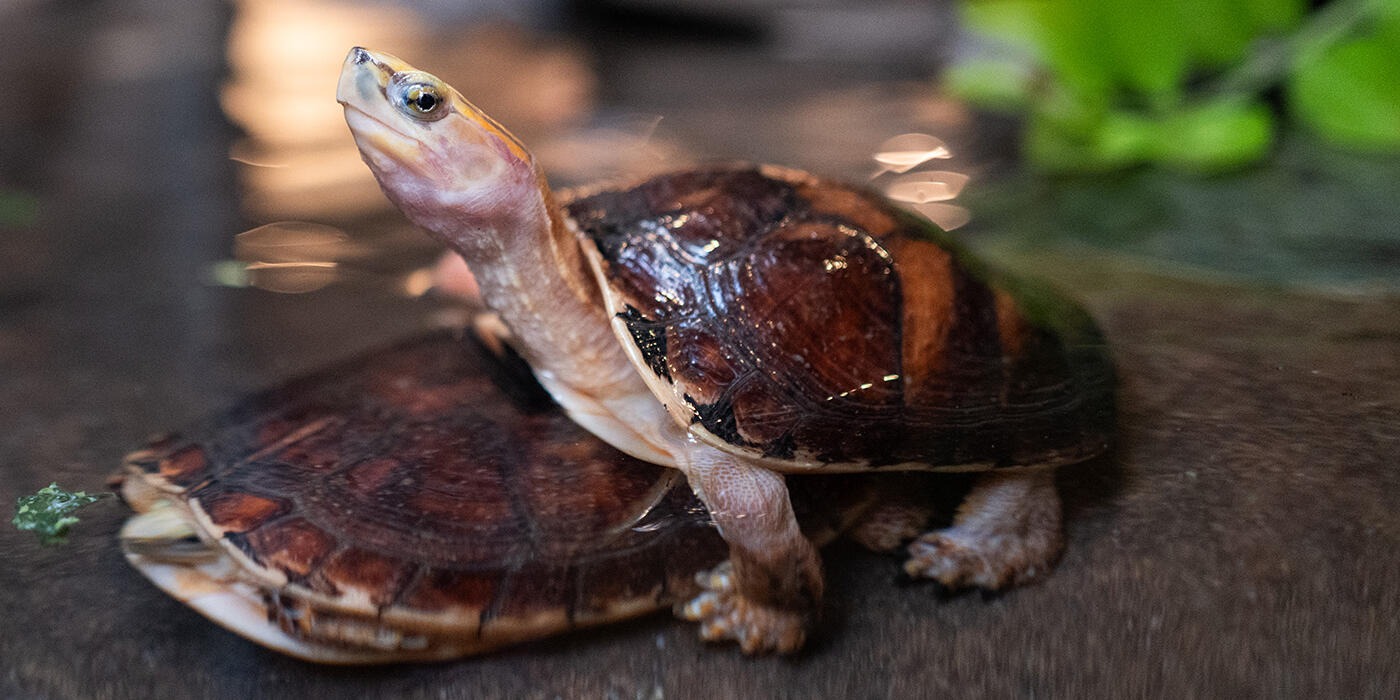
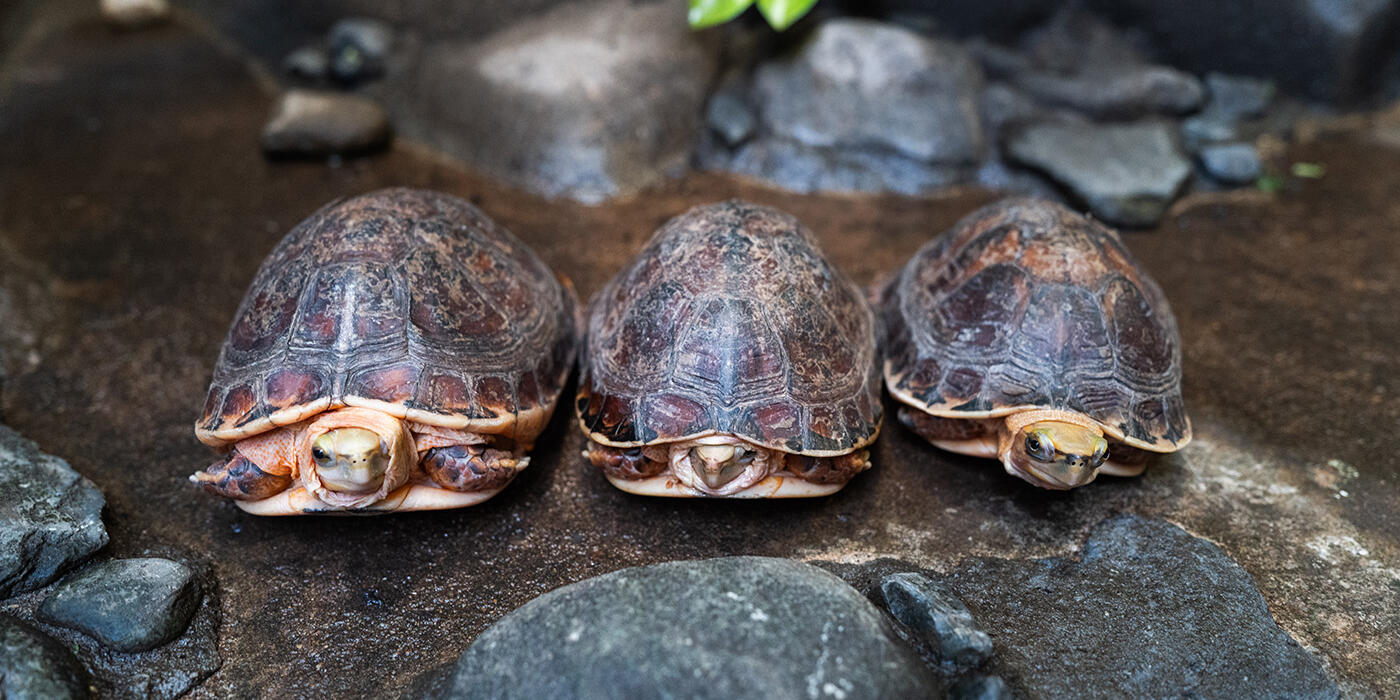
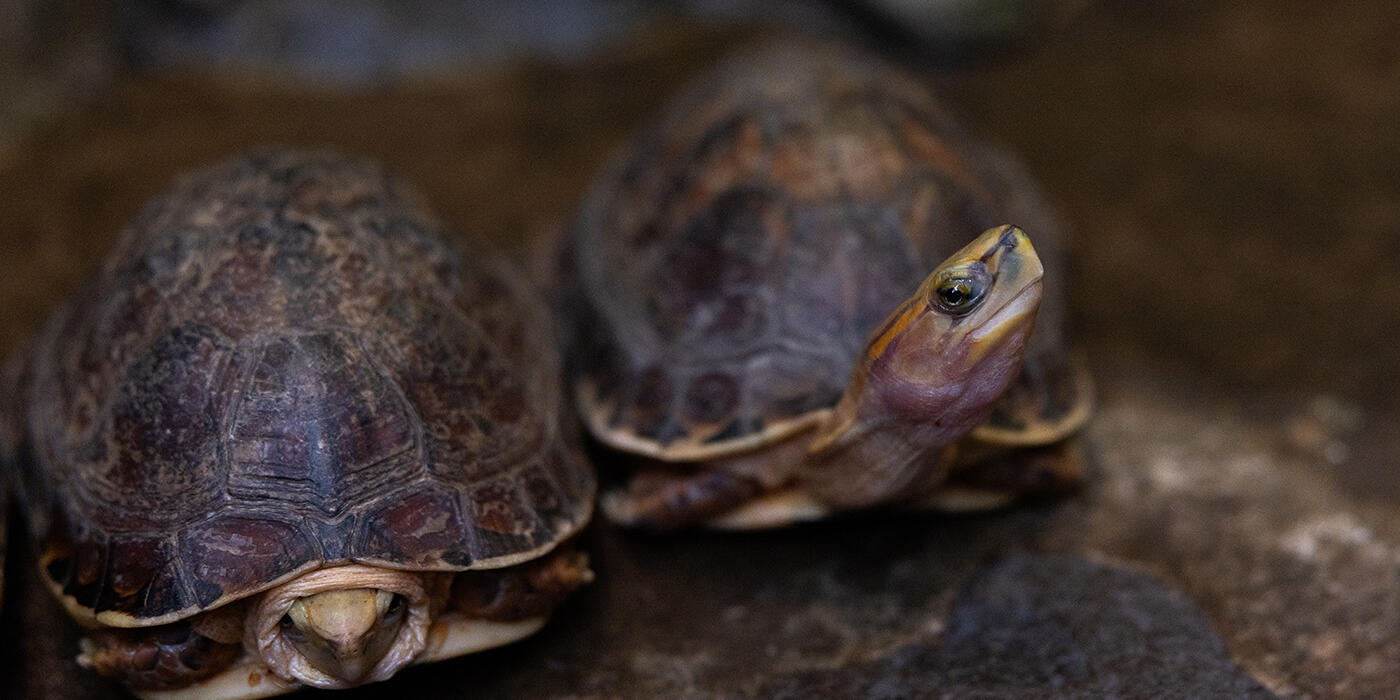
An extremely rare box turtle about which not much at all is known, the McCord’s box turtle lives only in the Guangxi province in central China. It is likely extinct in the wild.
Physical Description
McCord’s box turtle is a small turtle characterized by its dark brown shell and yellow tail, limbs, underside and pointed head. The stripe extending down the tail is thicker and longer in males than in females.
A flexible plastron (the bottom part of a turtle’s shell) allows this species to close its shell completely for protection.
Size
Their carapace, or shell, may reach between 5.3 and 6.5 inches (13.4 and 16.5 centimeters).
Native Habitat
McCord’s box turtle was first described scientifically when it was found in Chinese markets in the 1980’s. Their native habitat is within bamboo and broad-leafed forests of the Guangxi province of southern China.
Lifespan
The lifespan of this animal is unknown.
Food/Eating Habits
Little is known about the eating habits of this species in the wild, although they prefer a carnivorous diet to vegetation.
At the Smithsonian’s National Zoo and Conservation Biology Institute, McCord’s box turtles eat a diet consisting of earthworms, salad, smelt, and crickets.
Sleep Habits
This animal is nocturnal, and hides during the day by burrowing into the soft ground. They have been found hiding under plants.
Reproduction and Development
Little is known about the reproductive behaviors of the McCord’s box turtle.
Conservation Efforts
The Turtle Survival Alliance estimates that there are only a few scattered individuals left in the wild, if it is not in fact already extinct.
This species, along with several other Asian box turtles, is sold in markets for use in traditional medicine and in the pet trade. In particular, the McCord’s box turtle brings in a handsome sum of money as a rare pet. A concerning trend is the increased presence and use of online retailers to sell rare turtle species, many of which are captured from the wild.
Generally, freshwater species in this turtle’s wild habitat are affected by habitat destruction, changes in the clow of water due to the development of hydropower plants, and the pollution of fresh water sources. These factors, compounded with the little available information on this species and the continued rise of local and international trade, may lead to the extinction of this animal in the next decade.
In human care, breeding programs are underway in hopes of increasing the population of the McCord’s box turtle, though their native habitat is still too unstable for reintroduction. In North America, McCord’s box turtles are managed by a Species Survival plan coordinated by the Association of Zoos and Aquariums.
Help this Species
Practice ecotourism by being an advocate for the environment when you’re on vacation. During your travels, support, visit or volunteer with organizations that protect wildlife. Shop smart too! Avoid buying products made from animals, which could support poaching and the illegal wildlife trade.
Choose your pets wisely, and do your research before bringing an animal home. Exotic animals don’t always make great pets. Many require special care and live for a long time. Tropical reptiles and small mammals are often traded internationally and may be victims of the illegal pet trade. Never release animals that have been kept as pets into the wild.
Support organizations like the Smithsonian’s National Zoo and Conservation Biology Institute that research better ways to protect and care for this animal and other endangered species. Consider donating your time, money or goods.
Share the story of this animal with others. Simply raising awareness about this species can contribute to its overall protection.
Smithsonian's National Zoo and Conservation Biology Institute. (n.d.). McCord’s box turtle. Retrieved September 8, 2026, from https://www.nationalzoo.si.edu/animals/mccords-box-turtle
Animal News

8 Reasons Why Zoo Staff Think the Chacoan Peccary Might Be Your New Favorite Animal ›
Two animal care experts share why this new species might become your next obsession.

Look Back At Linh Mai’s Most Memorable Moments As She Turns 7 Months Old ›
Seven months ago, the world fell in love with a little Asian elephant named Linh Mai. As she turns 7 months old, we're taking a look back at her most memorable moments.

Three Adorable Red Panda Cubs Born This Summer at the Zoo’s Front Royal Campus ›
“The cubs are really just balls of fur that eat and sleep right now,” said Jessica Kordell, assistant curator of carnivores.