
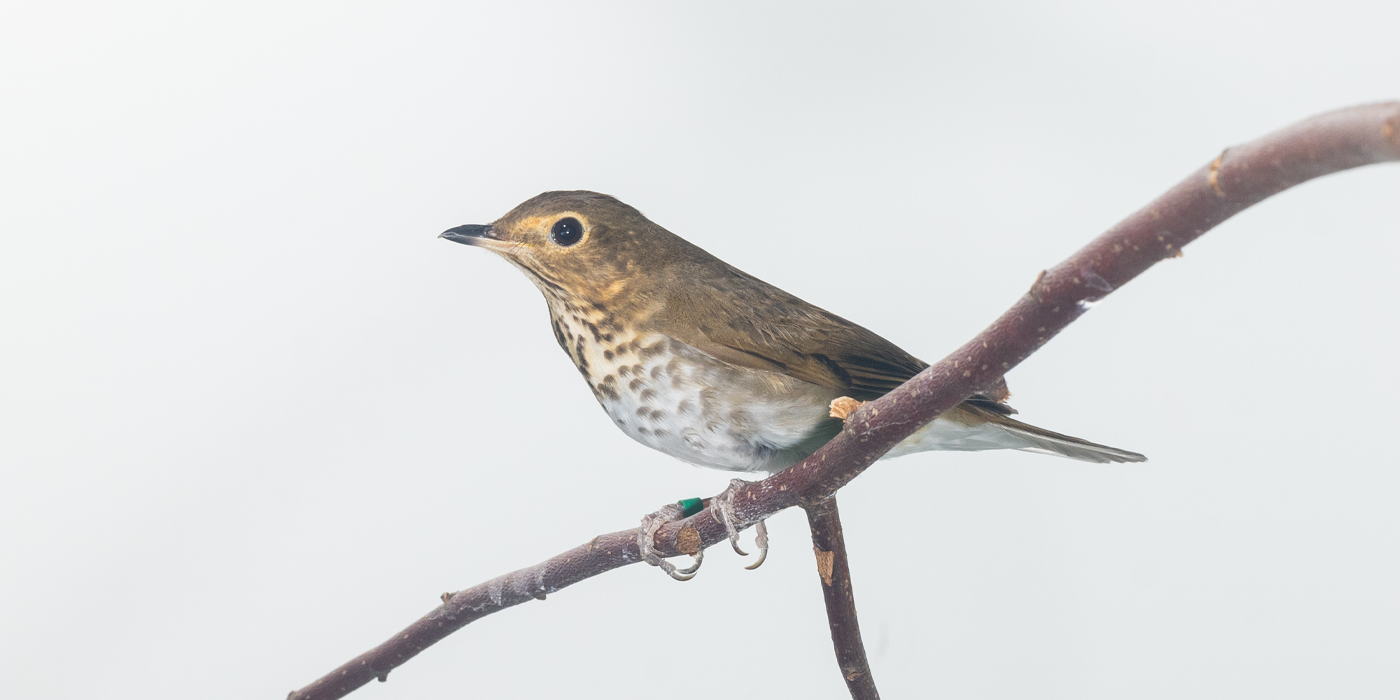
This sweet-singing forest bird travels across the Americas each year to reach its northern breeding grounds. It is known for its ascending, flute-like song.
Physical Description
Roughly the size and shape of an American robin, Swainson's thrushes have olive-brown to rust-brown colored upper-parts, and a cream-colored underside with pale brown spots that are clear on the chest and become smudgier further down on the belly. They also have a pale brown ring around the eye, dull pink legs, and a medium-length brown tail. Males and females have similar color patterns.
While it can be hard to tell apart from the hermit thrush and the veery, Swainson’s thrushes can be identified among its close cousins by the buff-colored ring around its eye.
Size
Native Habitat
Swainson's thrushes live in dense, thick forests with a mix of leafy trees and conifers. They prefer to be in areas with lots of undergrowth. While migrating, they are often spotted in forests, lake edges and suburban parks.
Their range extends across the United States during migration, stretching from Alaska and western Canada to the Atlantic Ocean, and down into the northern U.S. for the breeding season. Their wintering range extends from Mexico through Central and South America into northern Argentina. One subspecies can be found along the Pacific Coast from southern California to Alaska.
Lifespan
Communication
Food/Eating Habits
Sleep Habits
Social Structure
Reproduction and Development
During the breeding season, males reach the nesting grounds a few days ahead of the females, establishing their territory by singing and repelling other males. After choosing a mate, the female will build a cup-shaped nest out of twigs, moss, leaves and grasses. Females lay clutches of 3-4 pale blue eggs colored with brown spots. Incubation lasts about two weeks, and both parents care for the nestlings after hatching. After a steady diet of insects caught by their parents, the young are ready to leave the nest after about two weeks. Swainson’s thrushes will often return to the same site to breed year-over-year.
Conservation Efforts
Help this Species
Be a smart consumer. Choose products made with sustainable ingredients, such as Smithsonian certified Bird Friendly coffees, which support farmers striving to limit their impact on wildlife and habitat.
Practice ecotourism by being an advocate for the environment when you’re on vacation. During your travels, support, visit or volunteer with organizations that protect wildlife. Shop smart too! Avoid buying products made from animals, which could support poaching and the illegal wildlife trade.
Be a responsible cat owner, and keep cats indoors or under restraint when outside. Never release animals that have been kept as pets into the wild.
Conservation starts with you! Join a citizen science project where you can help collect valuable data for scientists. Encourage your friends and family to get involved too.
Plant native flowers in your garden to help feed resident and migrating pollinators. You'll make your lawn beautiful and help wildlife at the same time!
Never release balloons. Animals often mistake them for food or become entangled in their strings. Looking for an alternative? Try blowing bubbles instead!
Smithsonian's National Zoo and Conservation Biology Institute. (n.d.). Swainson's thrush. Retrieved September 5, 2026, from https://www.nationalzoo.si.edu/animals/swainsons-thrush
Animal News

8 Reasons Why Zoo Staff Think the Chacoan Peccary Might Be Your New Favorite Animal ›
Two animal care experts share why this new species might become your next obsession.

Look Back At Linh Mai’s Most Memorable Moments As She Turns 7 Months Old ›
Seven months ago, the world fell in love with a little Asian elephant named Linh Mai. As she turns 7 months old, we're taking a look back at her most memorable moments.

Three Adorable Red Panda Cubs Born This Summer at the Zoo’s Front Royal Campus ›
“The cubs are really just balls of fur that eat and sleep right now,” said Jessica Kordell, assistant curator of carnivores.