
Physical Description
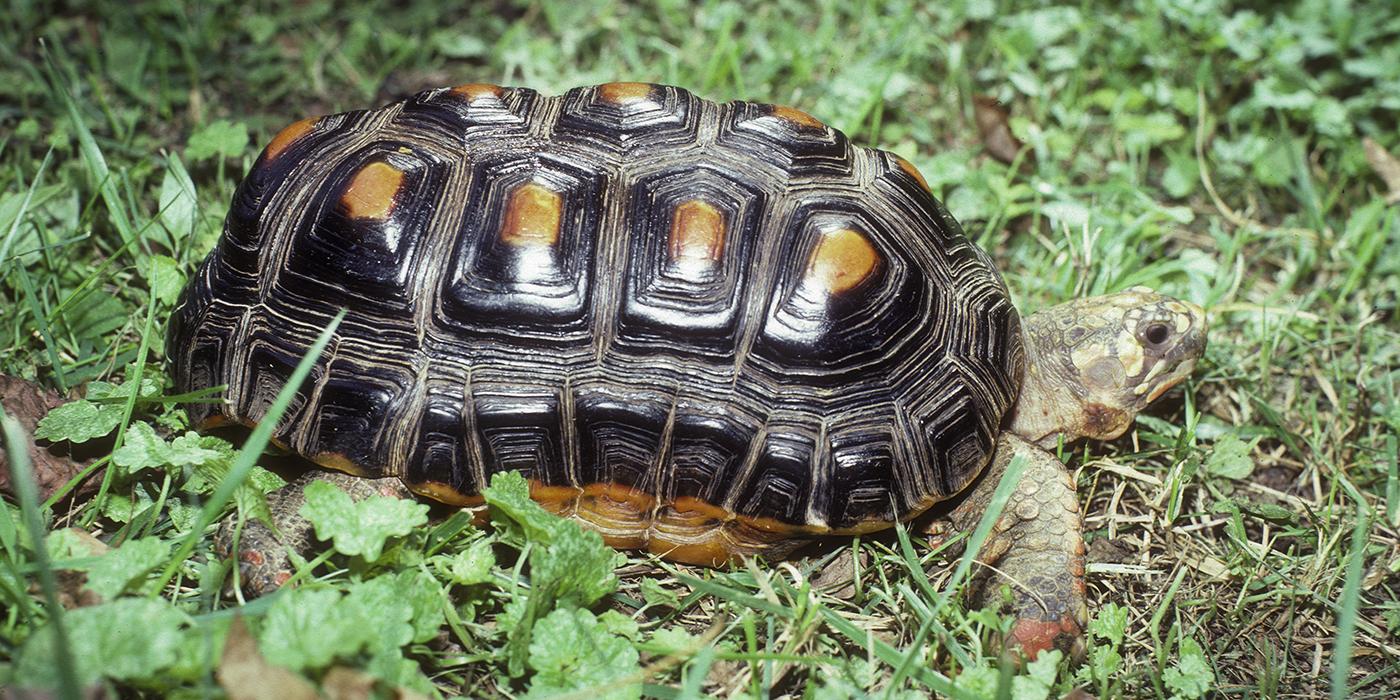
Red-footed tortoises have a concave, bumpy shell. Their skin is mostly black with shells being typically black, gray or brown. Young tortoises have small distinct areas of yellow or tan coloring surrounding or covering each bump. Bright red marks may appear on the head. The legs and tail often have patches of orange, yellow or red.
Size
Male red-footed tortoises are larger than females and grow up to 13.5 inches (34 centimeters) long. Females average 11.25 inches (28.5 centimeters) long. Adult male tortoises can weigh up to 20 pounds (9 kilograms).
Native Habitat
Red-footed tortoises live throughout South America from Panama to Argentina. They are also found on the Caribbean islands of Trinidad and Barbados. They live in dry and wet forests areas, grasslands and the savanna.
Lifespan
They frequently reach ages of 50 years or more.
Communication
Males and females use head movements as signals to identify each other.
Food/Eating Habits
Red-footed tortoises are primarily herbivorous but will also eat small amounts of animal matter, such as small invertebrates. Most of their food comes from leaves, grasses, fungi, fruits and flowers.
At the Smithsonian's National Zoo, they are fed a specially formulated tortoise feed that includes a balance of cellulose, carbohydrates, proteins and minerals such as calcium. They also receive dietary enrichment in the form of browse and occasional fruit.
Reproduction and Development
After mating, females bury five to 15 eggs in nests excavated in leaf litter on the forest floor. Incubation time in the nest varies with local conditions, but typically, eggs hatch after around 150 days.
Help this Species
Be a smart consumer. Choose products made with sustainable ingredients, such as Smithsonian certified Bird Friendly coffees, which support farmers striving to limit their impact on wildlife and habitat.
Practice ecotourism by being an advocate for the environment when you’re on vacation. During your travels, support, visit or volunteer with organizations that protect wildlife. Shop smart too! Avoid buying products made from animals, which could support poaching and the illegal wildlife trade.
Growing, transporting and preparing food uses a lot of resources, so choose local, seasonal produce when possible. A significant amount of food waste also ends up in landfills, so only buy what you can eat.
Smithsonian's National Zoo and Conservation Biology Institute. (n.d.). Red-footed tortoise. Retrieved August 18, 2026, from https://www.nationalzoo.si.edu/index%2ephp/animals/red-footed-tortoise
Animal News

How Smithsonian Science Is Helping the Scimitar-Horned Oryx Recover — and Thrive ›
Pushed to the brink of extinction by the year 2000, the oryx is turning into one of conservation's most impressive success stories, thanks in part to Smithsonian science.

11 Fascinating Facts About the Hellbender, North America’s Largest Amphibian ›
Hiding in Appalachia’s cool mountain streams is one impressively large salamander.

Happy 5th Birthday, Bao Li ›
Giant panda Bao Li celebrated turning 5 years old with a shark-themed birthday bash, complete with a fruitsicle "cake" and boat buoy enrichment.