
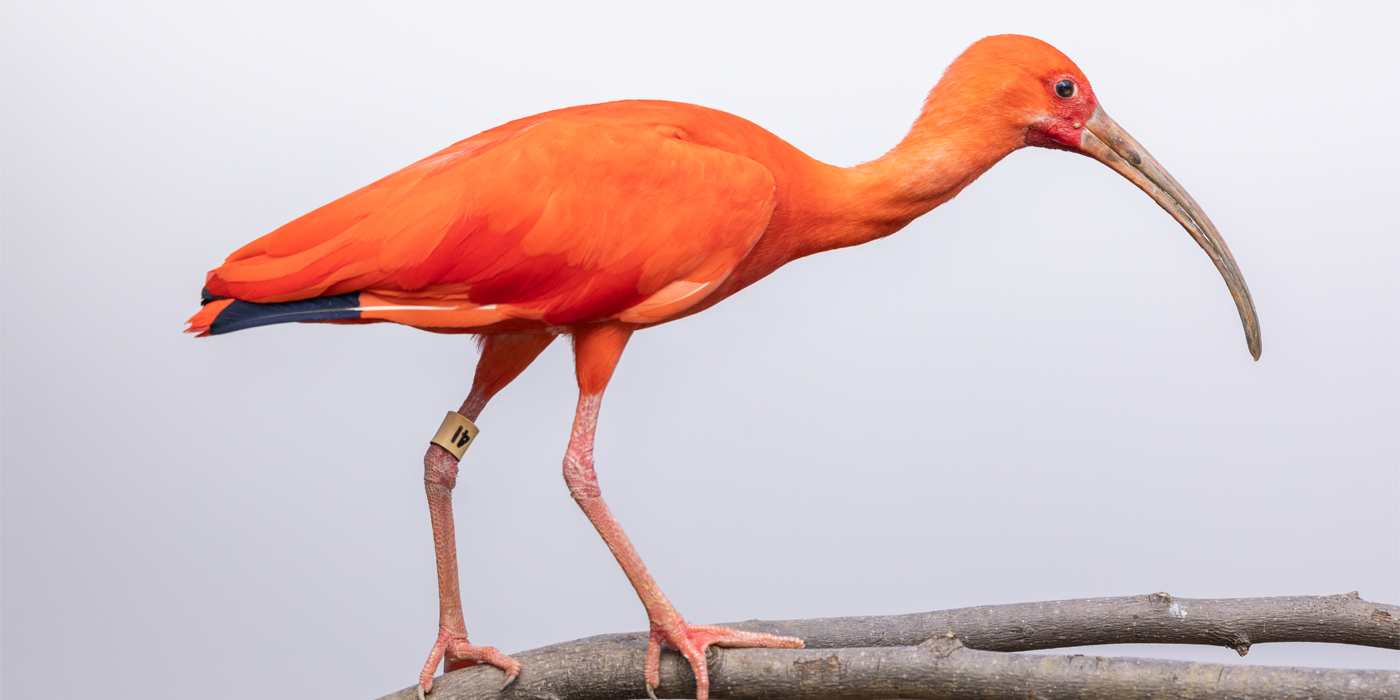
Physical Description
Size
Native Habitat
Lifespan
Communication
Food/Eating Habits
Social Structure
Scarlet ibises are social birds that form flocks of 30 or more individuals. A flock of ibises is called a “congregation”. These flocks often coexist with other bird species, forming a mutualistic relationship where each species works together for food, safety and protection.
Reproduction and Development
Scarlet ibises are polygynous, meaning one male may breed with multiple females. Males engage in courtship displays, such as preening and rocking, to attract potential breeding partners. Breeding pairs will also intertwine their necks during courtship.
In the Southern Hemisphere breeding typically occurs during mid-September, and the female lays a clutch of 3-5 pale green and brown-streaked eggs in November or December. In the Northern Hemisphere breeding and nesting season runs between June and August.
Nests are constructed in trees and are incubated by both parents for about three weeks. After the eggs hatch, chicks are cared for by both parents.
Young scarlet ibises can swim before they can fly. Baby ibises are born with soft, downy black feathers. It takes about 18 months for the feathers to fully develop into their adult red color. Chicks are usually capable of living on their own after about 35 days.
Conservation Efforts
Help this Species
Be a smart consumer! Avoid animal-skin products, even those marked “faux,” to ensure you’re not contributing to the illegal hunting of this species.
Practice ecotourism by being an advocate for the environment when you’re on vacation. During your travels, support, visit or volunteer with organizations that protect wildlife. Shop smart too! Avoid buying products made from animals, which could support poaching and the illegal wildlife trade.
Choose your pets wisely, and do your research before bringing an animal home. Exotic animals don’t always make great pets. Many require special care and live for a long time. Tropical reptiles and small mammals are often traded internationally and may be victims of the illegal pet trade. Never release animals that have been kept as pets into the wild.
Organize or attend a stream, river, lake or other waterway cleanup in your area to preserve aquatic habitats for local species.
Smithsonian's National Zoo and Conservation Biology Institute. (n.d.). Scarlet ibis. Retrieved August 21, 2026, from https://www.nationalzoo.si.edu/index%2Ephp/animals/scarlet-ibis
Animal News

Three Adorable Red Panda Cubs Born This Summer at the Zoo’s Front Royal Campus ›
“The cubs are really just balls of fur that eat and sleep right now,” said Jessica Kordell, assistant curator of carnivores.

How Smithsonian Science Is Helping the Scimitar-Horned Oryx Recover — and Thrive ›
Once pushed to the brink of extinction, the oryx is becoming one of conservation's most inspirational stories.

11 Fascinating Facts About the Hellbender, North America’s Largest Amphibian ›
Hiding in Appalachia’s cool mountain streams is one impressively large salamander.