
Physical Description
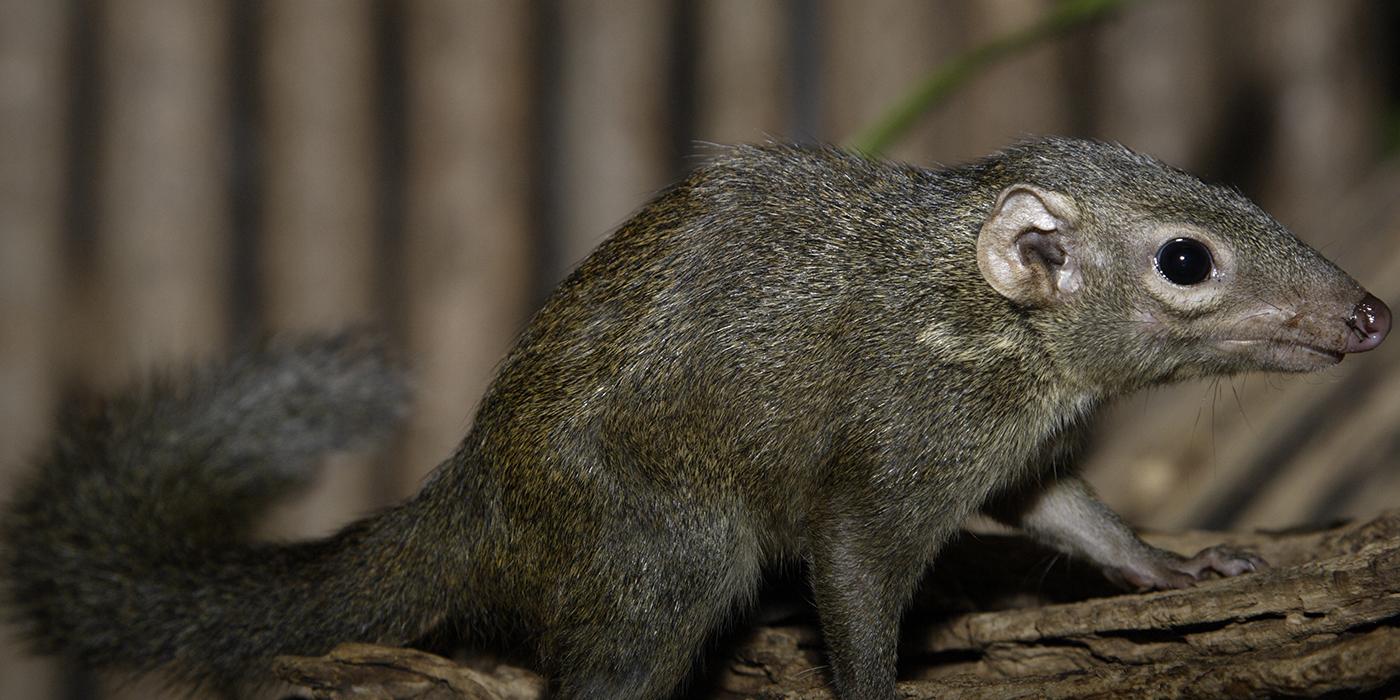
Northern tree shrews have grayish, olive fur. These animals are diurnal and territorial, marking their spots using scent gland located in the abdomen and chin.
Size
Their head and body are 5.5 to 9 inches (140 to 230 millimeters), and their tail is about the same length as their body.
Native Habitat
Tree shrews are broadly distributed across Southeast Asia, in eastern Nepal and Bangladesh, southeastern China, Indochina and the Malay Peninsula above the Isthmus of Kra, Hainan.
Northern tree shrews live in rainforests. They are sometimes arboreal, but are most often found on or near the ground level. During dry months when the leaf litter dries up and reduces the amount of prey available on the ground, they are found more frequently in the trees.
Food/Eating Habits
Tree shrews have a symbiotic relationship with pitcher plants, a group of plants with large, tube-shaped flowers. The flowers attract bugs into their pitchers, which they break down and digest. Tree shrews perch on the lid of the plant's pitcher and lick nectar from the bottom of the leaf. Then, they defecate inside of the tube. The pitcher breaks down the tree shrew excrement for nutrients. Whenever possible, keepers at the National Zoo house pitcher plans with our northern tree shrews to showcase this relationship.
In the wild, these tree shrews eat insects, mainly coleopterans (beetles), and fruit.
At the Smithsonian's National Zoo, northern tree shrews are fed chopped greens, grapes, oranges, apples, root vegetables, insectivore diet, mealworm larvae and crickets.
Sleep Habits
Northern tree shrews are diurnal, or active during the day.
Social Structure
Small social groups are composed of parents and their offspring until the young reach sexual maturity.
Male and female territories will frequently overlap, resulting in monogamous pairings. Although males and females do not interact often, they may share a burrow at night.
Reproduction and Development
Young are born shortly after the mild southwest monsoons, when insects are most plentiful. Females usually have a litter size of two and commonly breed once a year. The gestation period is 40 to 52 days, at the end of which young are placed in a nest separated from the parents. Mothers are unique among extant mammals in that they do not groom their young, clean the nest, or rescue their young if danger arises. They visit their offspring once every two days to nurse for about five minutes.
The short gestation period and rapid maturation of the young mean that tree shrews can breed rapidly if the conditions are right and they are able to colonize new areas quickly.
Conservation Efforts
Northern tree shrews have a wide range and substantial population size. They are also able to tolerate human disturbance and habitat manipulation.
Help this Species
Share the story of this animal with others. Simply raising awareness about this species can contribute to its overall protection.
Smithsonian's National Zoo and Conservation Biology Institute. (n.d.). Northern tree shrew. Retrieved August 2, 2026, from https://www.nationalzoo.si.edu/index%2Ephp/animals/northern-tree-shrew
Animal News

Peek Inside Our Bat-eared Fox Family’s Den ›
Feast your eyes on our frisky bat-eared fox kits—the first born here in 75 years—in this keeper Q&A!

Happy National Zookeeper Week 2026 ›
Join us in celebrating the dedicated professionals who care for our animal ambassadors!

Asian Elephant Calf Linh Mai Takes Her First Swim, Showing Off Her Pachyderm Paddle ›
Look who’s learning to “elephant paddle!” Linh Mai, our 5-month-old Asian elephant calf, reached a major milestone this week: baby’s first swim!