
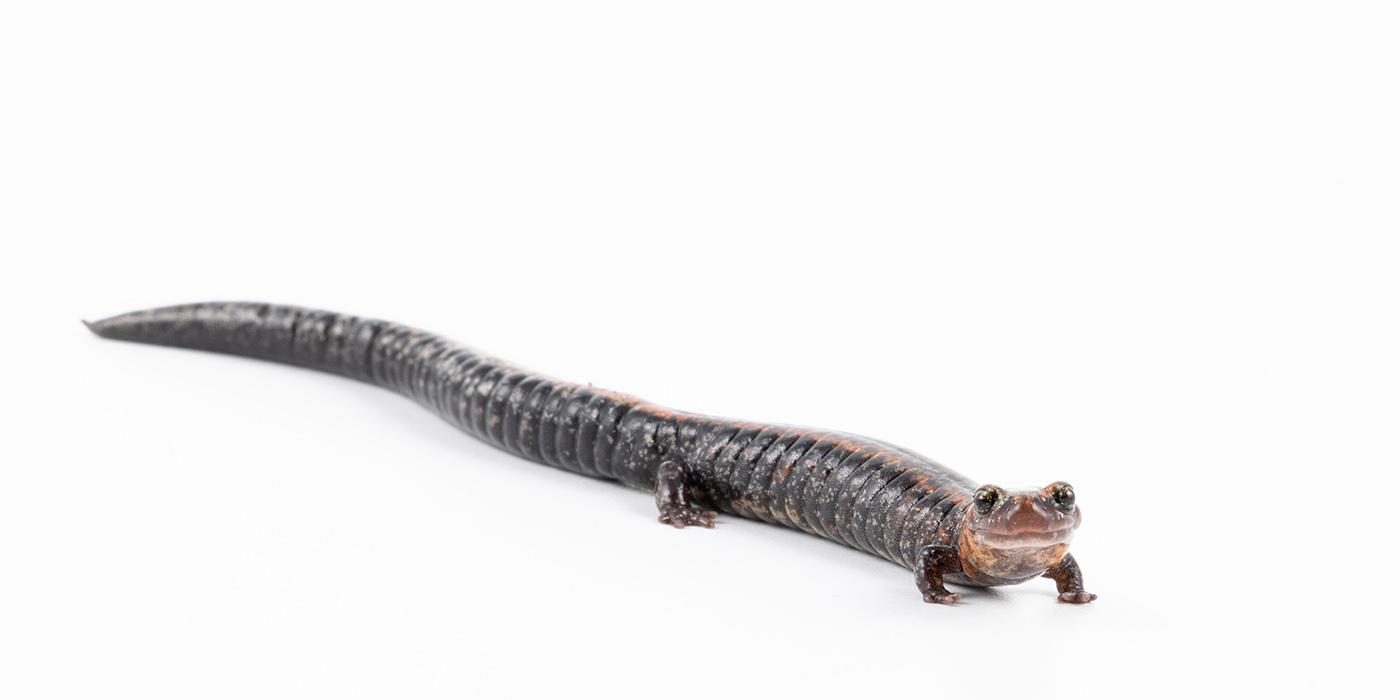
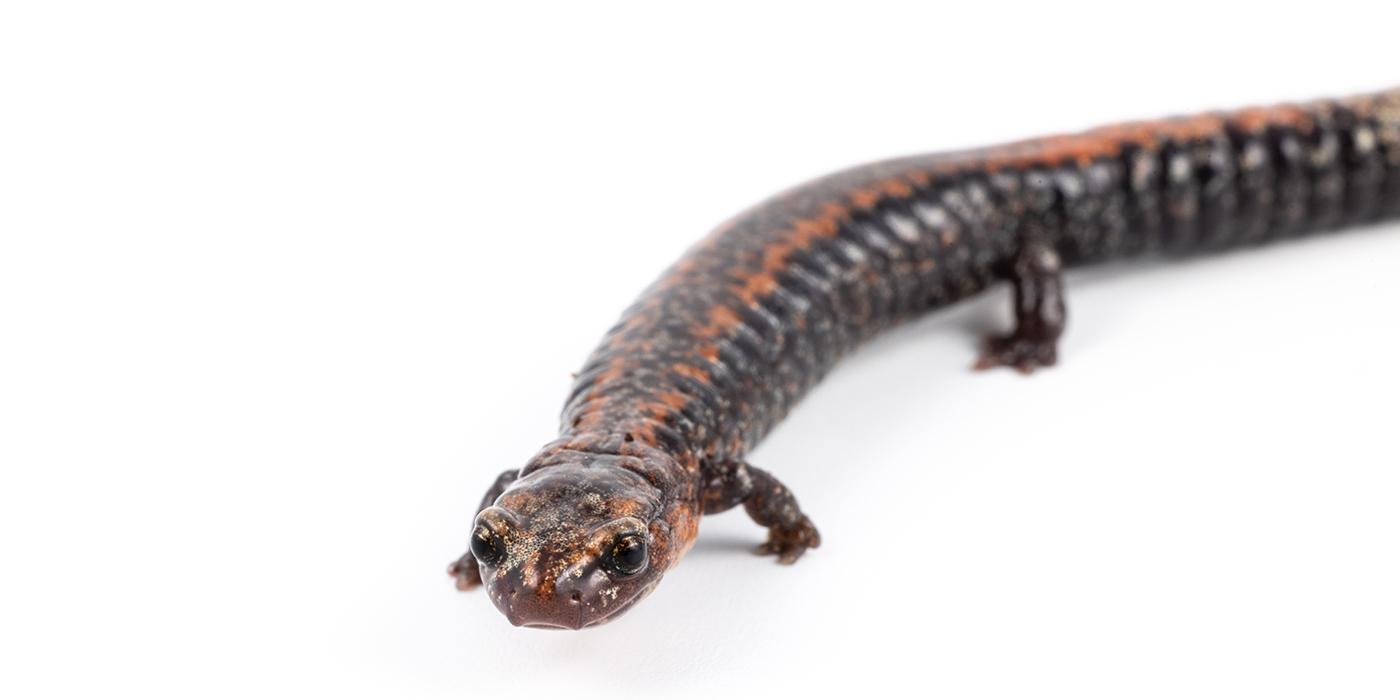
The Shenandoah salamander is one of the rarest salamanders in North America, only occurring on three mountain tops in Shenandoah National Park, Virginia. It is threatened by invasive insect species, competition with other native salamanders, and climate change.
Physical Description
Dark brown to black body with a red or bronze stripe down the back, which may be straight-edged or have a saw-toothed pattern. The stripe may be prominent or faint. Their belly is typically dark with white speckling.
Size
Roughly 2.5 inches to 4 inches (7 to 10 centimeters).
Native Habitat
Shenandoah salamanders are found on relatively dry, steep slopes with hardwood trees, where they live in moist soil pockets and rocks. The animal retreats deeper underground when conditions aboveground become too hot and dry in the summer or too cold in the winter.
Lifespan
Up to around 25 years.
Communication
Not much is known about how this species communicates, but their bodies feature several different glands that are likely used to send chemical signals, particularly during breeding season.
Food/Eating Habits
Hunting at night, the Shenandoah salamander eats mites, flies, small beetles, springtails, and other small soil-dwelling invertebrates.
Sleep Habits
This species is primarily nocturnal, spending the daytime hiding beneath objects such as rocks and logs.
Social Structure
This species is generally solitary, but they will defend small territories from members of their own species or the eastern red-backed salamander (Plethodon cinereus) which competes for food and space.
Reproduction and Development
Females lay an average of around 13 eggs in damp logs, moss, or moist crevices every other year in late spring or early summer. This species does not have an aquatic larval stage. Instead, hatchlings emerge as miniature adults after a period of one to three months developing inside the egg. Mother salamanders guard their eggs while their young are developing and will stop eating to remain by their side.
Conservation Efforts
The Shenandoah salamander is vulnerable to extinction by virtue of its extremely restricted range, and its population is also experiencing numerous different threats.
Climate change is warming and drying out the salamander’s mountain habitat, squeezing it to higher elevations as temperatures rise. Invasive gypsy moths and wooly adelgids also kill trees and reduce canopy cover in the salamander’s forest habitat.
The Shenandoah salamander also has a native competitor for resources in its preferred habitats: the eastern red-backed salamander (Plethodon cinereus).
The species’ entire range is protected within Shenandoah National Park but unfortunately this can’t protect the salamander from climate change or from the competing eastern red-backed salamander.
Additional research into the extent of this species’ range as well as what its specific needs and preferences are could enhance future conservation efforts.
Help this Species
Practice ecotourism by being an advocate for the environment when you’re on vacation. During your travels, support, visit or volunteer with organizations that protect wildlife. Shop smart too! Avoid buying products made from animals, which could support poaching and the illegal wildlife trade.
Support organizations like the Smithsonian’s National Zoo and Conservation Biology Institute that research better ways to protect and care for this animal and other endangered species. Consider donating your time, money or goods.
Share the story of this animal with others. Simply raising awareness about this species can contribute to its overall protection.
Are you a student? Did you love what you learned about this animal? Make it the topic of your next school project, or start a conservation club at your school. You'll learn even more and share the importance of saving species with classmates and teachers, too.
Smithsonian's National Zoo and Conservation Biology Institute. (n.d.). Shenandoah salamander. Retrieved September 25, 2026, from https://www.nationalzoo.si.edu/animals/shenandoah-salamander
Animal News

Happy 5th Birthday, Qing Bao ›
To celebrate giant panda Qing Bao's birthday, keepers went "far out" and created a 1970s-themed party full of bright colors and iconic pop culture slogans.

See These 5 New Animals at Your Next Visit to the Smithsonian's National Zoo ›
From a spunky new sloth to a dazzling electric eel, get ready to meet the newest residents making themselves at home.

Happy 50th 'Zooniversary' to Chyna and Rulon, the Zoo’s Aldabra Giant Tortoises ›
There are plenty of objects and artifacts at the Smithsonian that are old. But at the National Zoo, there's not much older than Rulon and Chyna.