
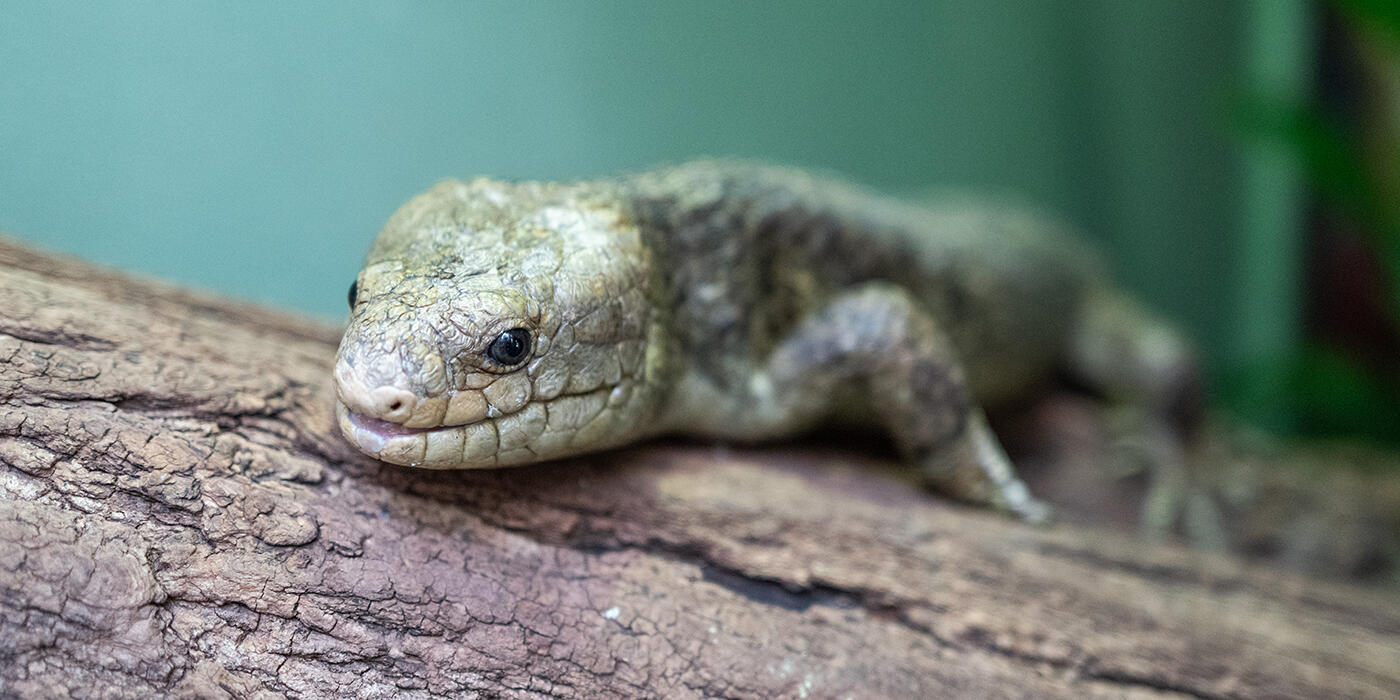
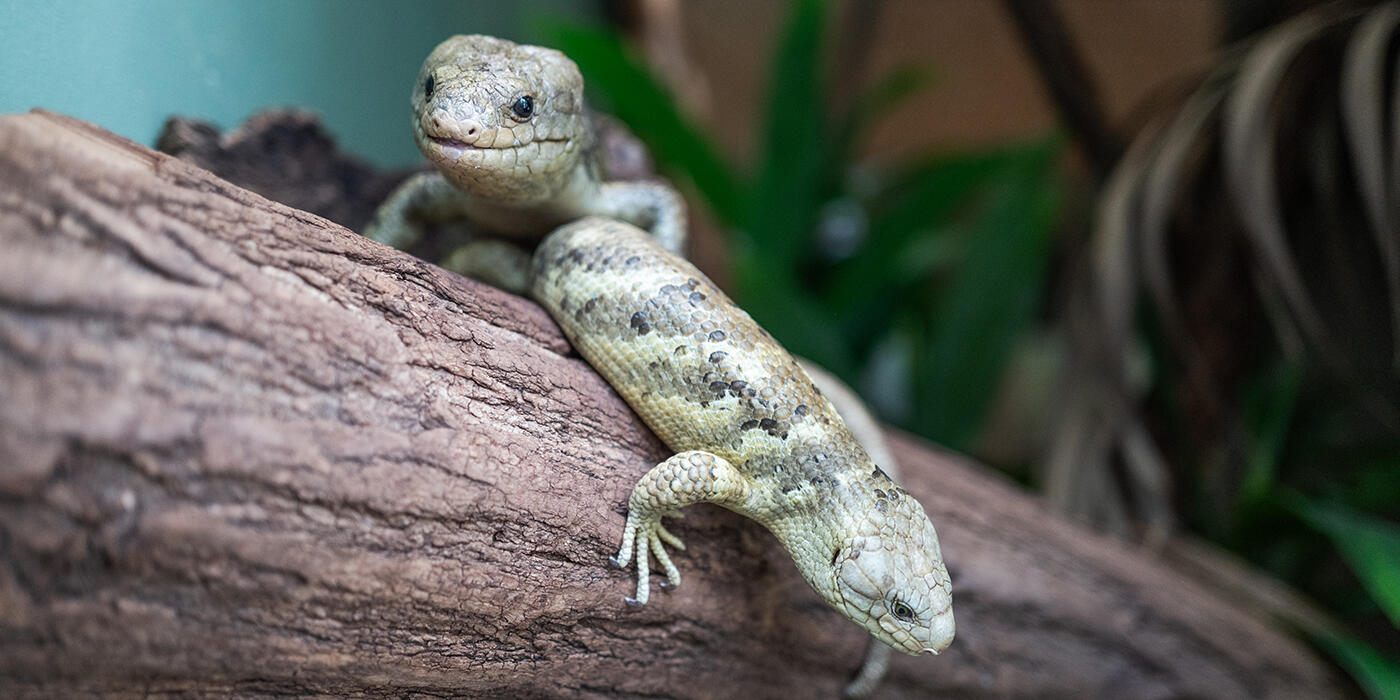
The prehensile-tailed skink is a tree-dwelling species of lizard native to the Solomon Islands, a group of islands north of Australia. This animal is mostly vegetarian and lives in small, communal groups.
Physical Description
Prehensile-tailed skinks have large, flat heads with small eyes, and rely primarily on their sense of smell. They have flat, overlapping scales that are dark in color, often with brown or black speckling, with an underside varying in color from yellow to different shades of green.
Male prehensile-tailed skinks tend to have a broader head and a more slender body shape than do female skinks. Males appear to have a V-shaped pattern of scales just in front of the cloacae, which the females do not have.
In addition to their prehensile tails, they have thick, curved nails that aid in climbing and gripping tree limbs. Since the tail is prehensile and used as another appendage, they do not have the ability to shed it when attacked by a predator.
Size
They have a long, slender body that can reach up to 28 inches (72 centimeters) from snout to top of tail. They typically weigh between 14 and 28 ounces.
Native Habitat
Prehensile-tailed skinks are an arboreal (tree-dwelling) species that live high in the rainforest canopy. They are commonly found in strangler fig trees.
Lifespan
It is thought that prehensile-tailed skinks can live between 15 and 25 years in captivity.
Sleep Habits
They are nocturnal and crepuscular, active at dawn and dusk, either hanging from branches or hiding in tree hollows during the day.
Social Structure
Prehensile-tailed skinks are one of very few species of reptiles known to form a communal social grouping called a circulus.
However, both males and females are territorial and can be hostile towards skinks that are not part of the group.
Reproduction and Development
Prehensile-tailed skinks reproduce by a process called viviparous matrotrophy, where the females provide a placenta for its young, which develop inside the mother. Young skinks are born live after a gestation period of six to eight months. Single births are most common, although twins are possible. Newborns are roughly a third the size of adults. Newborns will stay within their family group for six to 12 months, during which time they are protected by parents and other unrelated adult skinks within the group. At about one year of age, juveniles will move out to form a new family group.
Conservation Efforts
While not considered endangered, the population is under serious threat due to extensive logging as well as consumption for food by indigenous Solomon Islanders. Excessive exports for the pet trade have impacted wild populations, and the practice is now prohibited.
Help this Species
Practice ecotourism by being an advocate for the environment when you’re on vacation. During your travels, support, visit or volunteer with organizations that protect wildlife. Shop smart too! Avoid buying products made from animals, which could support poaching and the illegal wildlife trade.
Choose your pets wisely, and do your research before bringing an animal home. Exotic animals don’t always make great pets. Many require special care and live for a long time. Tropical reptiles and small mammals are often traded internationally and may be victims of the illegal pet trade. Never release animals that have been kept as pets into the wild.
Support organizations like the Smithsonian’s National Zoo and Conservation Biology Institute that research better ways to protect and care for this animal and other endangered species. Consider donating your time, money or goods.
Share the story of this animal with others. Simply raising awareness about this species can contribute to its overall protection.
Avoid single-use plastics, such as plastic bottles, bags and utensils. Choosing reusable options instead can help reduce plastic pollution.
Smithsonian's National Zoo and Conservation Biology Institute. (n.d.). Prehensile-tailed skink. Retrieved September 13, 2026, from https://www.nationalzoo.si.edu/animals/prehensile-tailed-skink
Animal News

Happy 5th Birthday, Qing Bao ›
To celebrate giant panda Qing Bao's birthday, keepers went "far out" and created a 1970s-themed fête full of bright colors and iconic pop culture slogans.

See These 5 New Animals at Your Next Visit to the Smithsonian's National Zoo ›
From a spunky new sloth to a dazzling electric eel, get ready to meet the newest residents making themselves at home.

Happy 50th 'Zooniversary' to Chyna and Rulon, the Zoo’s Aldabra Giant Tortoises ›
There are plenty of objects and artifacts at the Smithsonian that are old. But at the National Zoo, there's not much older than Rulon and Chyna.