
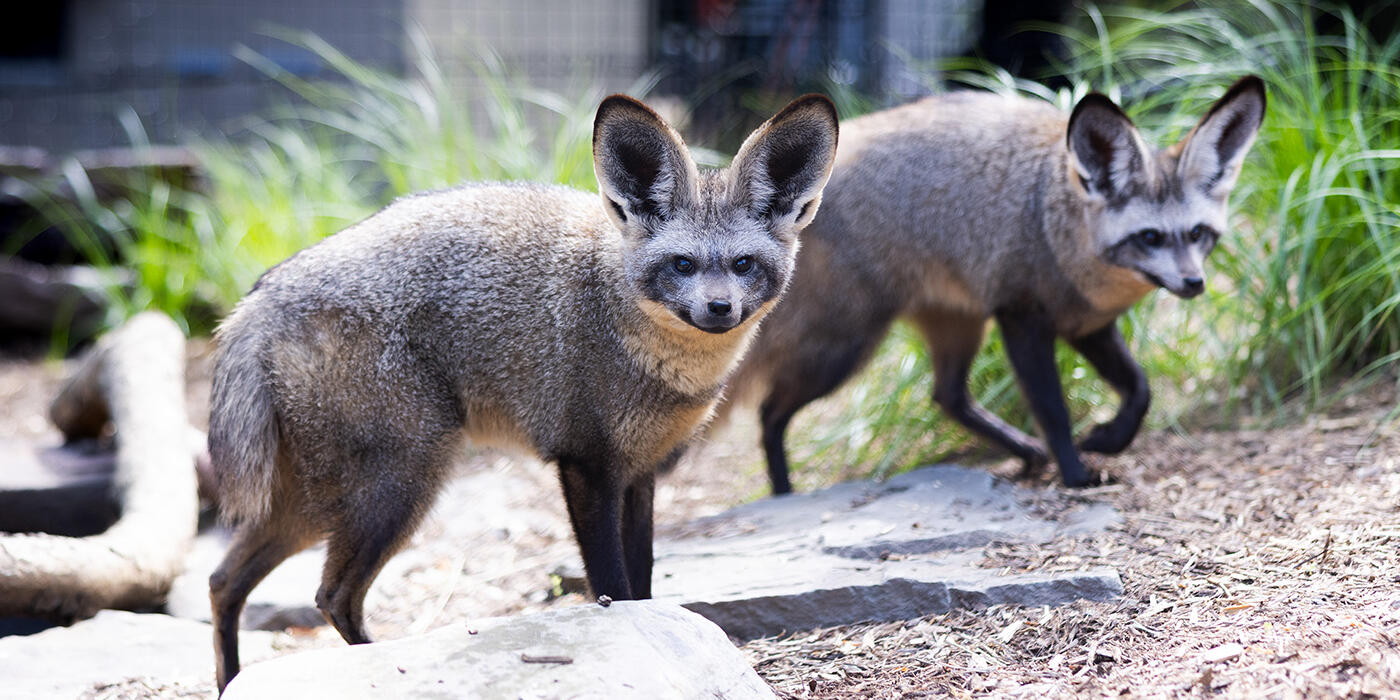
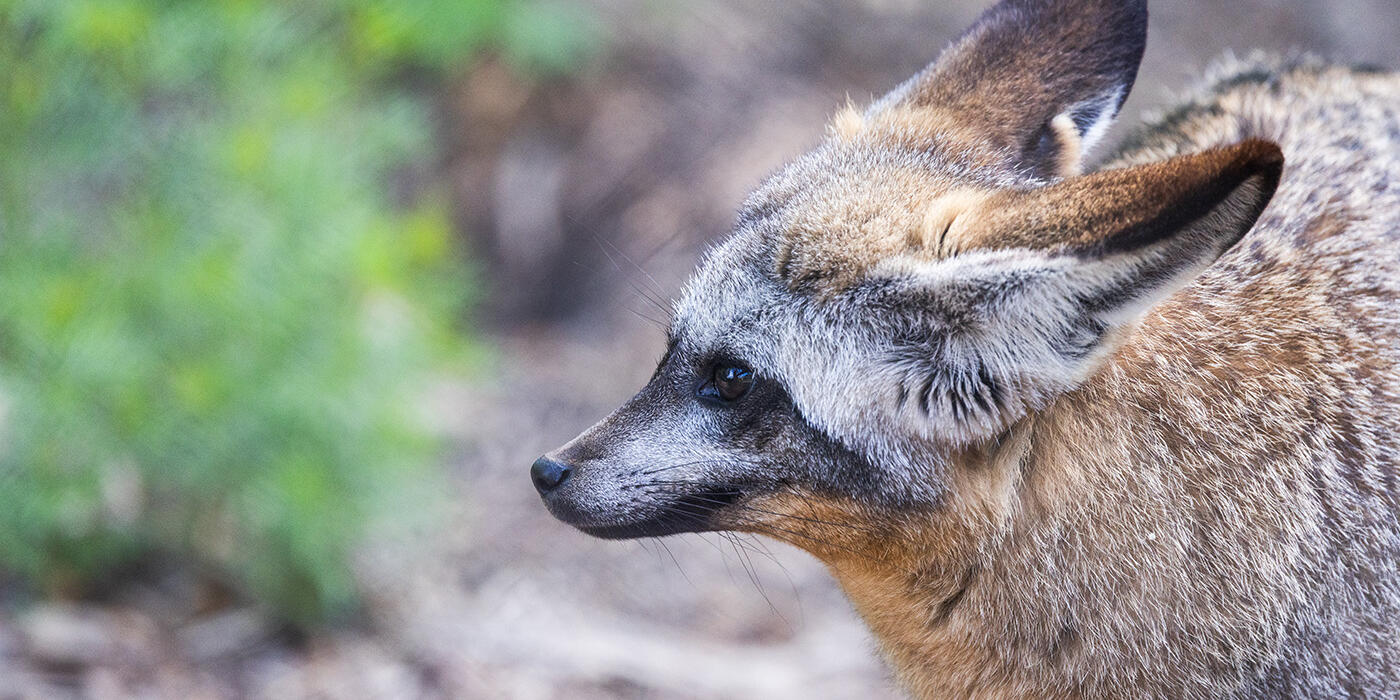
Native to the grasslands and savannas of Africa, the bat-eared fox is known for its distinctive large ears. This carnivore specializes in eating insects, relying on its exceptional hearing to locate termites underground.
Size
Among the smallest canids, adult bat-eared foxes typically weigh 6-10 pounds (3-4.5 kilograms) with bodies 18-26 inches (46-66 centimeters) long, plus a 12-inch (30 centimeter) tail.
Native Habitat
They can be found in short grass plains, savannas, and semi-arid scrublands across Africa.
Lifespan
Wild bat-eared foxes live for around 6 years. In human care, individuals can live for up to 13 years.
Communication
Bat-eared foxes are quite social and rely on various methods to communicate with other members of their species. They make a number of vocalizations, including growls, barks, yips and soft whistles that can serve as alerts, contact calls, and aggressive warnings to other foxes.
Bat-eared foxes also rely on body language and physical cues, such as swishing their tails or rotating their ears, to coordinate during hunting and mating activities. Like many other canines, these foxes also use scent-marking to establish territory and seek mates.
Food/Eating Habits
Primary insectivorous. Around 90-95% of a bat-eared foxes' diet is made up of insects, specifically harvester termites, plus worms, beetles, and grubs. They also occasionally hunt small prey like mice, birds, eggs and lizards, and will sometimes eat fruits, berries, seeds and plant material.
Sleep Habits
As nocturnal animals, bat-eared foxes rest in underground burrows during the day and emerge when night falls.
Social Structure
Bat-eared foxes are fairly social, and will form pairs or small groups (usually a mating pair with offspring.)
Mated pairs hunt for food and defend territories together. Both parents share responsibilities while caring for their young (called “kits”). Male bat-eared foxes (called a “dog”) provide most of the early parental care for the kits, allowing the female (called a “vixen”) to focus on eating enough food to produce milk. As the kits grow up, the family unit reinforces social bonds through cooperative activities like social grooming, playing and sharing prey.
Occasionally, multiple family groups will form a loose-knit group. Scientists believe this cooperative approach can help the animals maximize their odds of survival in the harsh African savannah.
Reproduction and Development
Bat-eared foxes form monogamous dating pairs, usually mating for life. Dogs and vixens pair up after reaching sexual maturity, which occurs when the animals reach 8 or 9 months old. Females scent mark to signal their readiness to reproduce. After mating, females are pregnant between 60 and 70 days and give birth to a litter of one to six pups.
From the protection of their self-dug burrows, females nurse the young for about 14-15 weeks, occasionally leaving to forage for food to maintain milk production. During this time, the males take on most of the parenting and kit-rearing responsibilities. Males protect and raise the kits inside the burrow, groom the kits, and occasionally transport the youngsters to a new den site. After 5-6 months, when the kits are old enough to fend for themselves, they leave their parents to establish a new territory.
Conservation Efforts
Major threats to certain bat-eared fox populations include habitat loss, environmental degradation, and predation from larger animals like lions and hyenas. Bat-eared foxes are also threatened by human activities like illegal hunting and capture for the pet trade.
Although many live in nature reserves and other protected areas, bat-eared foxes are becoming more common near farms, villages and other human-dominated environments.
Help this Species
Practice ecotourism by being an advocate for the environment when you’re on vacation. During your travels, support, visit or volunteer with organizations that protect wildlife. Shop smart too! Avoid buying products made from animals, which could support poaching and the illegal wildlife trade.
Choose your pets wisely, and do your research before bringing an animal home. Exotic animals don’t always make great pets. Many require special care and live for a long time. Tropical reptiles and small mammals are often traded internationally and may be victims of the illegal pet trade. Never release animals that have been kept as pets into the wild.
Consider going meat-free one day each week to help reduce the demand on the livestock industry and decrease your carbon footprint!
Share the story of this animal with others. Simply raising awareness about this species can contribute to its overall protection.
Meet the Animals
The Smithsonian's National Zoo is home to four bat-eared foxes.
Lando is a male bat-eared fox. He was born May 15, 2023, at the San Diego Zoo Safari Park in California. He came here in 2024 at the recommendation of the Association of Zoos and Aquariums’ Species Survival Plan (SSP).
Lando is a little skittish and can often be found near his exhibit mate, Ziggy.
Ziggy is a female bat-eared fox. She was born on Apr. 10, 2024, at Zoo Knoxville in Tennessee. She came here in 2025 as part of the SSP managed breeding program.
She was born with a partial tail, which makes her easy to identify. She is the more confident of the pair and likes interacting with keepers to receive her favorite snacks – mice, mealworms, and waxworms.
In 2026, Ziggy gave birth to a pair of male kits named Han and Solo.
Want to find the animals? Check inside the wooden boxes, hollow logs, tall grasses, and sunny spots at the back of the exhibit. Bat-eared foxes typically sleep during the day and can often be found curled up asleep somewhere where they feel safe.
Smithsonian's National Zoo and Conservation Biology Institute. (n.d.). Bat-eared fox. Retrieved September 21, 2026, from https://www.nationalzoo.si.edu/animals/bat-eared-fox
Animal News

Happy 5th Birthday, Qing Bao ›
To celebrate giant panda Qing Bao's birthday, keepers went "far out" and created a 1970s-themed fête full of bright colors and iconic pop culture slogans.

See These 5 New Animals at Your Next Visit to the Smithsonian's National Zoo ›
From a spunky new sloth to a dazzling electric eel, get ready to meet the newest residents making themselves at home.

Happy 50th 'Zooniversary' to Chyna and Rulon, the Zoo’s Aldabra Giant Tortoises ›
There are plenty of objects and artifacts at the Smithsonian that are old. But at the National Zoo, there's not much older than Rulon and Chyna.